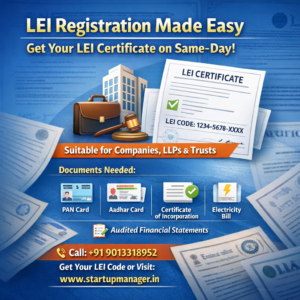
What is LEI Registration?
LEI (Legal Entity Identifier) is a unique 20-character alphanumeric code issued to companies and legal entities that engage in financial transactions. It helps identify businesses participating in global financial markets and ensures transparency in financial reporting. Every company dealing in securities, forex, or other financial instruments must have an LEI code as per regulatory requirements. At Startup Manager, expert Chartered Accountants assist in obtaining the LEI code quickly and efficiently. The entire process is online, and the LEI certificate is delivered directly to the client after successful registration.
Documents Required for LEI Registration
To apply for an LEI code, the following documents are required:
- Certificate of Incorporation or Business Registration Proof
- PAN Card of the entity
- Address Proof of the registered office (Electricity Bill, Rent Agreement, etc.)
- Authorized Signatory ID Proof (Aadhaar Card, PAN, or Passport)
- Board Resolution or Authorization Letter (if applicable)
- Audited Financial Statements or Latest Annual Report
All documents must be clear and valid to ensure smooth processing of the LEI application.
LEI Registration Process
The LEI registration process with Startup Manager is simple and fully online:
- Submit Documents – Upload the required documents through the online form.
- Verification by Experts – The CA team verifies all details and prepares the LEI application.
- Application Submission – The verified application is submitted to the LEI issuing authority.
- LEI Code Generation – Once approved, the LEI code is generated and shared with the client.
- Receive LEI Certificate – The official LEI certificate is delivered via email.
The entire process usually takes 1–2 working days after document submission.
LEI Renewal Process
The LEI code is valid for one year from the date of issuance. It must be renewed annually to remain active and compliant. The renewal process includes:
- Verification of Existing LEI Details
- Submission of Updated Documents (if any)
- Payment of Renewal Fee
- Renewal Confirmation and Certificate Issuance
We startup manager ensures timely renewal reminders and complete assistance in renewing the LEI code before expiry.
Why Choose Us for LEI Registration?
Choosing Startup Manager for your LEI registration means partnering with a team of qualified Chartered Accountants who specialize in financial compliance and regulatory services. We understand that businesses often find the LEI registration process confusing or time-consuming, so our experts handle everything from start to finish—ensuring accuracy, speed, and complete peace of mind. With years of experience in corporate compliance, GST, ITR, and financial services, Startup Manager has built a strong reputation for reliability and professionalism. Our goal is to make LEI registration simple, affordable, and accessible for every business entity in India.
Related Services: